Do I Belong Here?
Learning in Public About Imposter Syndrome
I recently found myself in a room filled with brilliant women. To be honest, it’s my favorite part of my job. They asked me to assist them with problem and thought I might be able to help. I admire these women tremendously. They are smart, experienced, thoughtful, and amazing at their jobs.
Almost immediately, the voice in my head started:
What am I doing here? They don’t need me. I don’t have anything to offer that they couldn’t figure out themselves.
And then, as if to prove my imposter syndrome right, they started talking. One person built on another person’s idea. Someone raised a question. Someone else saw a possibility. And before long, they were finding their way toward an answer.
I felt like a fly on the wall.
I’ve thought a lot about that meeting since, and I realized something important; maybe they didn’t need me to have the answer. Maybe that wasn’t my job in the first place.
Maybe My Value Isn't Having the Answer
My imposter syndrome tells me my contributions need to be valuable, I need to know something other people don’t. I need to offer insight, or solve the problem. However, that’s not where I do my best work.
I’ve come to understand that I’m a good listener… like actually listening. I can be a reflective mirror for people. I can synthesize what I’m hearing, capture what’s emerging, ask questions, and sometimes be the catalyst that helps other people find their own best answers. That’s different from being the person with the answer. And I’m learning this is just as valuable.
When my imposter syndrome shows up, it diffuses my strengths. I over prepare. I think through every possible scenario. I replay conversations in my head over and over again. Sometimes, by the time I show up, I’m so caught up in my own thoughts that I’m not even listening anymore. In trying so hard to prove that I deserve to be in the room, I can lose access to the very thing I bring to the room.

The Stories We Tell Ourselves
A different version of imposter syndrome shows up for me when I’m teaching or speaking. If someone has heard me speak before, sometimes I wonder why they come again.
Surely you’ve heard this already. You could probably teach this yourself. You likely have better examples than I do.
Part of me that believes I’m most valuable when I’m in front of new people who don’t already know the material.
However, I’ve learned that that probably isn’t true either.
I’ve spent years working on my craft. I’ve collected different stories and examples. I’ve learned new ways of talking about ideas. And I know people often need to encounter an idea more than once, in different ways, before it really sticks.
But knowing all of that doesn’t necessarily make the other voice disappear. And that’s the thing about imposter syndrome. You can know better and still feel it.
What Happens When the Stakes Get Higher
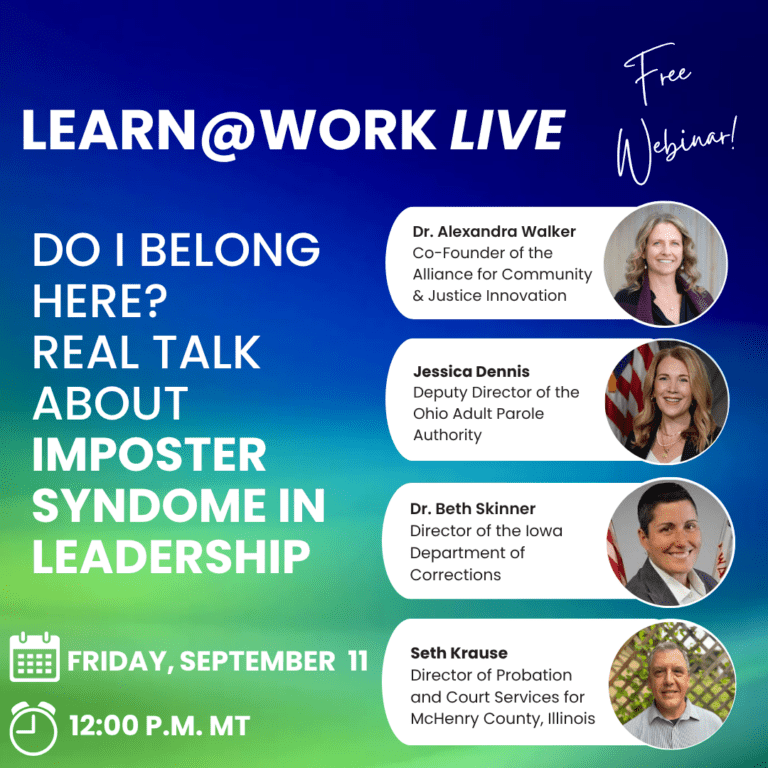
I’ve been thinking about this a lot because on September 11th, 2026 I’m moderating a Learn@Work LIVE conversation with three people I admire tremendously: Jessica Dennis, Deputy Director of the Ohio Adult Parole Authority; Dr. Beth Skinner, Executive Director of the Iowa Department of Corrections; and Seth Krause, Director of Probation and Court Services for McHenry County, Illinois.
These are dynamic, accomplished leaders doing incredibly impactful work. And guess what? They experience imposter syndrome, too. I wasn’t surprised when Beth, Jessica, and Seth agreed to talk about it. Versions of this conversation have come up between us before. But I think there is something powerful about putting the four of us together and saying it publicly:
Yep. Me too.
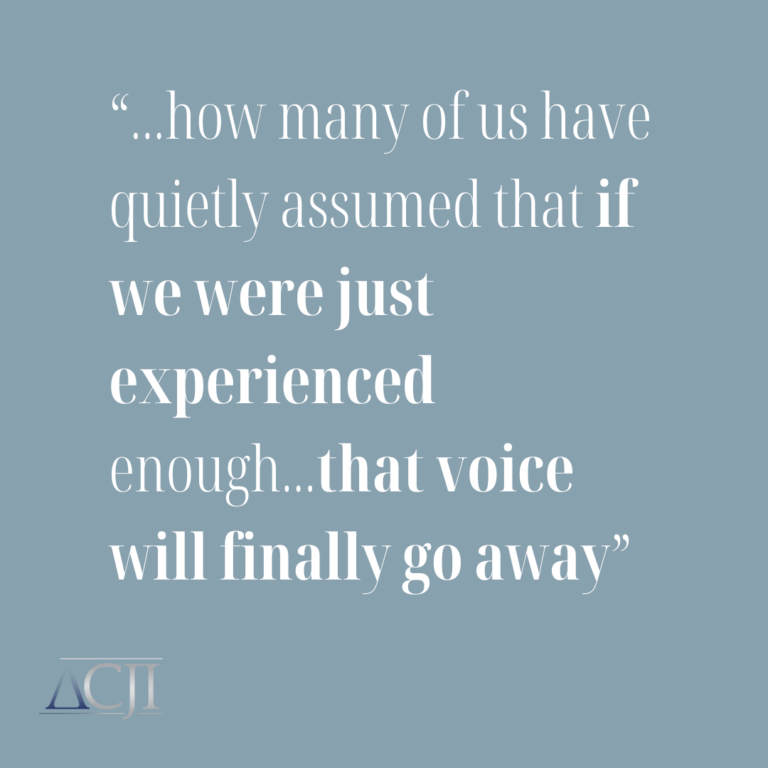
Because when we look at accomplished leaders from the outside, we see the position. The experience. The competence. The confidence. The accomplishments. We don’t hear what they’re telling themselves inside their own heads. And I wonder how many of us have quietly assumed that if we were just experienced enough, successful enough, or accomplished enough, that voice will finally go away. But what if it doesn’t? What if it is just a part of our human experience?
This conversation is particularly important in criminal justice. We work in systems where mistakes can have enormous consequences. Someone can get hurt. Something can end up on the news. A decision can have implications for an individual’s freedom, a family’s future, or the safety of a community. Understandably, our systems tend to be risk-averse.
We have policies. Procedures. Rules. Established ways of doing things. And many of us have been conditioned throughout our careers to follow them carefully. There are very good reasons for that.
But leadership also requires us to step beyond what we already know. It asks us to try something different. Challenge an assumption. Have a conversation we’ve never had before. Make a decision without having every piece of information we’d like. Lead people somewhere we haven’t been ourselves. And I wonder if some of the moments when we feel most like imposters aren’t evidence that we’re in the wrong place at all.
Maybe sometimes they’re evidence that we’re stretching.
Learning in Public
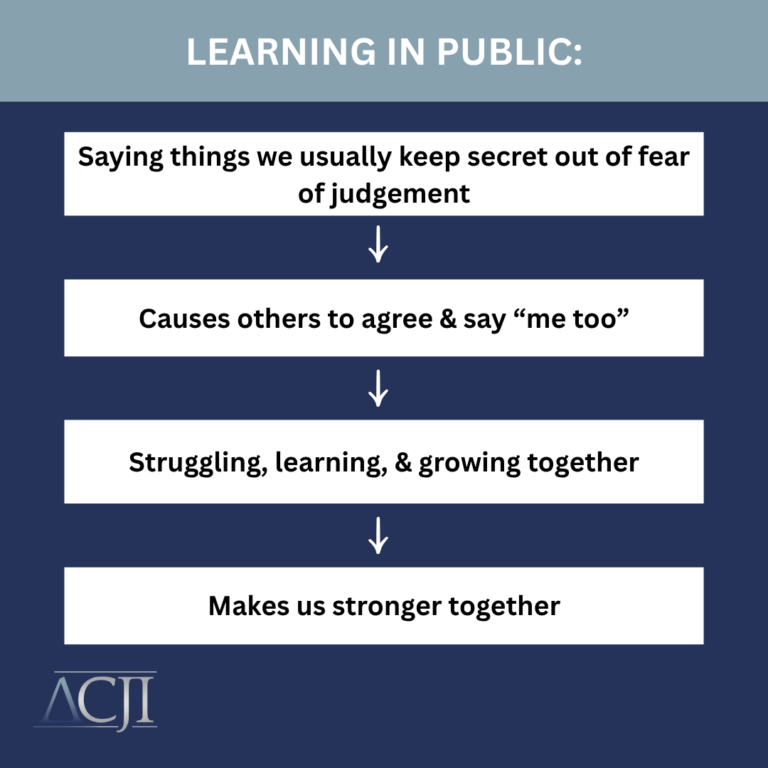
I don’t know that my goal anymore is to eliminate imposter syndrome. I’m becoming more interested in what happens when we talk about it. I’ve come to think of this as learning in public. For me, learning in public means saying some of the things we usually keep secret because we’re afraid of what people will think of us.
I’m questioning myself. Perfectionism is getting in my way. I’m telling myself a story that may not be true. I’m not sure. I’m still figuring this out.
There’s vulnerability and risk in that. But I’ve discovered that when I talk openly about my insecurities and the narratives I’m thinking, other people often say some version of:
Me too.
Bringing More Humanity Into Leadership
Maybe that’s a part of the leadership culture we need to create. Not one where competence doesn’t matter, because it absolutely does. Not one where leaders don’t have to make difficult decisions or take responsibility, because they absolutely do. But one where being a leader doesn’t require pretending to be finished. Where we can be…
- Deeply competent and still uncertain
- Experienced and still learning
- Confident and occasionally scared
- A leader and still a human being
That’s the conversation I want to have with Jessica, Beth, and Seth. We’re not coming together because the four of us have figured out how to conquer imposter syndrome. I don’t think any of us would claim that.
We’re coming together to talk about what it actually sounds like inside our heads; How it has changed as we’ve grown in our careers; When it gets in our way; What helps; And what might happen if leaders were more willing to let other people see some of the learning happening behind the confidence.
We are unlikely to figure out imposter syndrome in an hour. But we’ll talk about it. We’ll learn about it in public. And maybe bringing a little more humanity into our work starts there.
Join us September 11th, 2026 at 12:00 PM Mountain Time for ACJI’s Learn at Work LIVE: “Do I Belong Here?” Real Talk About Imposter Syndrome in Leadership. Click here to register.