Psychological Safety Is More Than Speaking Up
It's About Building Cultures Where People Can Thrive.
Organizations often ask a simple question: “How do we get people to speak up?”
It is an important question, but perhaps an even more important one is this:
What kind of organizational culture makes speaking up feel safe in the first place?
On Friday, July 10, ACJI’s Glenn Tapia joined Dr. Alex for a candid conversation on psychological safety as part of our Learn@Work LIVE series. The discussion brought together leaders and practitioners from across the United States, the United Kingdom, and beyond, representing courts, probation, corrections, human services, behavioral health, and other public-serving organizations. While the professions and locations varied, one theme quickly emerged: healthy organizations are built on trust, connection, and the courage to engage in honest conversations.
Psychological Safety is the Presence of Connection
One of the central ideas explored was that psychological safety is not simply the absence of fear. It is the presence of meaningful human connection.
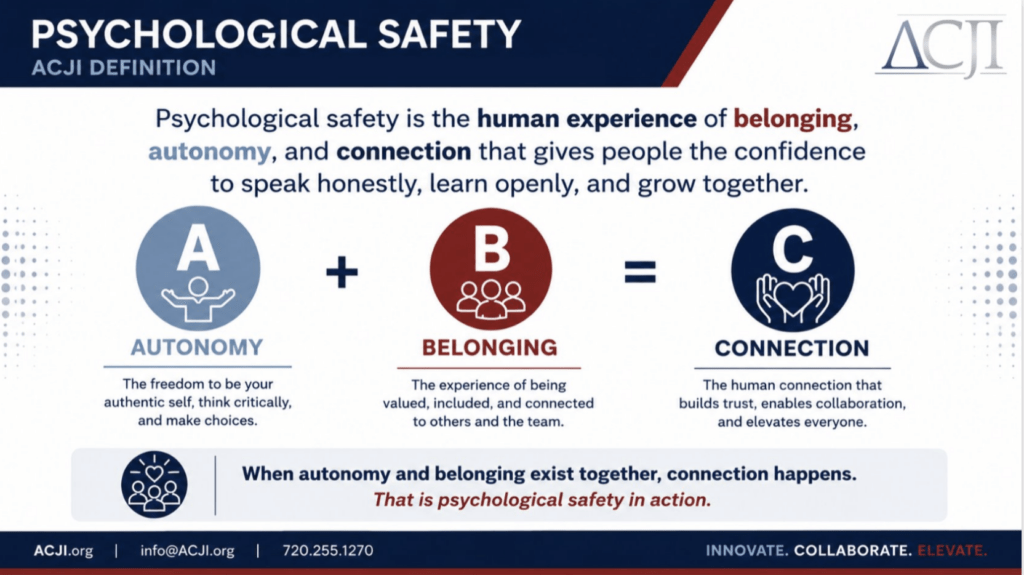
Too often, organizations define psychological safety as encouraging employees to “speak up.” While voice is certainly important, voice alone does not create a healthy culture. Psychological safety develops when people experience both autonomy and belonging. People need the freedom to think independently, contribute authentically, and express concerns while also feeling connected to something larger than themselves.
Balancing Autonomy and Belonging
At ACJI, we often describe this as the healthy balance between autonomy and belonging. Organizations need both. Too much autonomy without belonging can create isolation. Too much belonging without autonomy can unintentionally discourage independent thinking. Healthy organizations intentionally cultivate both because that balance creates genuine psychological safety.
Culture is Built Everyday
Another important theme was that culture cannot be improved through occasional events or symbolic gestures. Employee appreciation days, recognition programs, or inspirational speeches certainly have value, but they cannot replace the everyday experiences employees have with their leaders and colleagues. Culture is shaped through thousands of daily interactions, conversations, decisions, and behaviors. Psychological safety is not an event. It is an ongoing leadership practice.
Two Warning Signs of an Unsafe Culture
The conversation also explored two common warning signs that psychological safety may be struggling: groupthink and pseudo-silence.
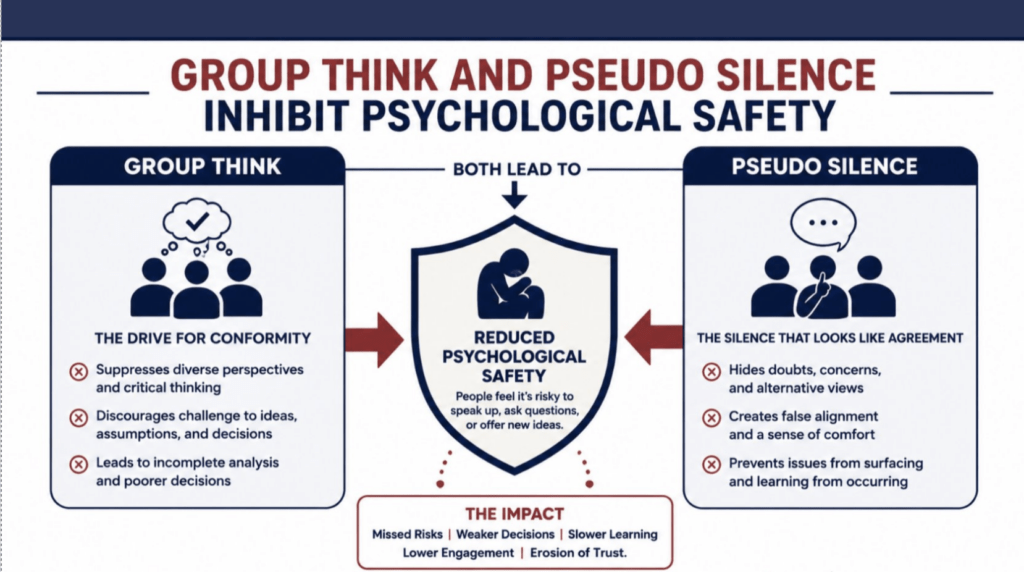
Groupthink occurs when people suppress independent thinking in order to fit in with the group. Rather than offering different perspectives, employees begin to believe that agreement is safer than honesty. While this may reduce conflict in the short term, it often limits creativity, innovation, and sound decision making.
Pseudo-silence is different, but equally damaging. People have ideas, concerns, or questions but choose not to voice them publicly. The real conversation happens after the meeting, in text messages, hallway conversations, or private offices instead of in the room where decisions are being made. Organizations often mistake quiet meetings for healthy agreement when, in reality, silence may simply signal that people do not feel safe enough to disagree.
The Connection Between Psychological Safety and Burnout
One of the most encouraging aspects of the discussion was hearing participants openly share their own experiences. Comments highlighted the importance of talking with people rather than at people, leaders demonstrating humility and vulnerability, and creating workplaces where every voice matters. Others reflected on the challenge of leading healthy cultures when psychological safety is lacking higher in the organization. These honest observations reinforced an important truth: psychological safety is not created through policy alone. It is built through relationships.
Another thought-provoking discussion centered on burnout. Is burnout simply an individual issue, or is it also an organizational issue?
The answer is likely both.
Prolonged stress can weaken organizational culture, while unhealthy organizational cultures can contribute to chronic stress, disengagement, and burnout. Leadership behaviors, communication patterns, workload, trust, and organizational norms all influence whether people experience work as energizing or emotionally exhausting. Addressing burnout, therefore, requires more than helping individuals become more resilient. It also requires organizations to examine the systems, cultures, and leadership practices that either support or undermine employee well-being.
Everyone Shapes Organizational Culture
Perhaps the most hopeful takeaway was the reminder that psychological safety is not reserved for executives or formal leaders. Every person contributes to the culture others experience. Every conversation, every meeting, every response to a mistake, and every moment of curiosity or compassion either strengthens or weakens the environment around us.
Building Healthy Cultures Through Intentional Leadership
This belief sits at the heart of ACJI’s IDEATE™ Culture Academy and our broader approach to organizational development. Healthy cultures do not emerge by chance. They are intentionally designed through leadership behaviors that foster trust, learning, engagement, and continuous improvement. Psychological safety is not about lowering expectations or avoiding accountability. It is about creating an environment where people feel safe enough to contribute their best thinking, ask difficult questions, learn from mistakes, and help one another succeed.
Psychological Safety is a Strategic Advantage
As organizations continue to navigate workforce shortages, rapid organizational change, increasing complexity, and growing expectations, psychological safety is becoming less of a “soft skill” and more of a strategic organizational capability. Organizations that intentionally cultivate trust, connection, belonging, and authentic dialogue are better positioned to innovate, adapt, and sustain high performance over time.
A Final Takeaway
The conversation concluded with a simple but powerful reminder that reflects ACJI’s philosophy toward culture and leadership:
Healthy organizations are not built because people are afraid to fail. They are built because people feel safe enough to learn, courageous enough to contribute, and connected enough to help one another succeed.