
If you are in a leadership role, you are probably busy. Not the normal kind of busy, but the relentless, reactive, always-behind kind. The kind where your calendar is full, your inbox never stops, and the most important work somehow keeps getting pushed to “later.”
Here’s the thing. In a VUCA world, the real challenge is not time management. It is attention management.
Volatile, uncertain, complex, and ambiguous environments do not respond well to hustle, control, or perfectly optimized calendars. They require something far more human and far more difficult. Focus, intention, and the ability to decide what truly deserves your attention.
Why VUCA Breaks Traditional Leadership Habits
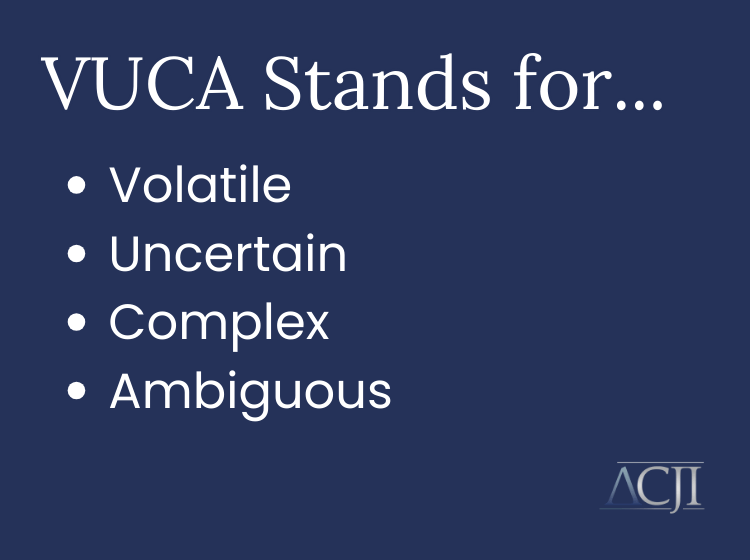
VUCA describes the reality most leaders face:
- Change is fast and unpredictable
- Information is incomplete or contradictory
- Problems are interconnected and messy
- Meaning is unclear until after decisions are made
In this environment, familiar leadership tools start to fall apart. Strategic plans become outdated before the ink dries. Root cause analyses oversimplify. Policies multiply, but clarity does not.
When uncertainty rises, most of us default to doing more, like more meetings, emails, and rules. It feels productive, but it often increases noise and reduces learning.
This is where adaptive leadership asks us to do something different.
Adaptive Leadership Starts With You
Adaptive challenges are not broken systems waiting to be fixed. They are living systems doing exactly what they are designed to do based on habits, incentives, beliefs, and relationships.
That is why adaptive change begins with leaders looking inward before pushing outward.
Not because everything is your fault, but because your attention, energy, and behavior shape what gets reinforced every day. What you pay attention to signals what matters. What you ignore quietly teaches people what does not.
In complexity, leadership is less about having answers and more about asking better questions, noticing patterns, and creating the conditions for learning.
The Adaptive Space Requires a Different Kind of Focus
Adaptive work lives in what we call the adaptive space. This is the space where the old ways no longer work, and the new ways are not yet clear.
In this space:
- Waiting for perfect information increases risk.
- Speed can create more problems than it solves.
- Control often produces resistance.
- Learning happens through experimentation, not certainty.
The challenge is that adaptive work does not scream for attention the way crises do. Fires demand immediate response. Adaptive challenges quietly persist in the background, stealing capacity over time.
Leading here requires intentionally shifting attention away from constant reaction and toward what actually moves the system.
Attention Is the Leadership Skill of This Moment
Many leaders say they do not have time to work on the most important issues. The truth is more uncomfortable and more hopeful. We all have the same number of hours. What differs is what gets our attention.
Attention management is the practice of choosing, again and again, where your energy goes.
It means:
- Being clear about what matters most right now
- Noticing when your attention is being pulled by urgency instead of importance
- Creating space to think, reflect, and learn, even when it feels uncomfortable
- Resisting the illusion that multitasking is effective
Research consistently shows that our brains are not built to focus on multiple things at once. Every interruption has a cost. In adaptive leadership, that cost often shows up as shallow solutions to deep problems.
Focus Over Speed, Intention Over Activity
Adaptive leadership values focus more than speed and direction more than destination.
This looks like:
- Building on what already works instead of abandoning the past
- Treating experimentation as progress, not failure
- Valuing diverse perspectives over top-down certainty
- Naming losses and discomfort that come with change
- Allowing time for learning, sensemaking, and adjustment
When leaders slow down their attention, organizations often speed up their learning.
Delegation Is an Attention Strategy
Delegation is not about doing less. It is about doing what only you can do.
When leaders hold onto everything, they unintentionally starve adaptive work. Delegation frees attention for:
- Diagnosing complex challenges
- Holding difficult conversations
- Building trust and alignment
- Supporting learning across the system
It also develops others, distributes leadership, and reduces burnout. In complexity, no one person can carry the work alone.
Why This Matters Now
Adaptive challenges persist because they cannot be solved with authority alone. They require shifts in mindset, behavior, and coordination among the people closest to the problem.
That means leadership is not about fixing. It is about mobilizing.
And mobilizing others starts with managing your own attention so you can model focus, curiosity, and intentionality amid uncertainty.
An Invitation to Practice Adaptive Leadership
ACJI’s Adaptive Leadership Academy is designed for leaders who are tired of spinning and ready to work differently. Over eight weeks, we focus on real challenges, real experiments, and the daily practices that make adaptive leadership possible.
If you are navigating complexity, change fatigue, or persistent challenges that refuse to budge, you are not alone. And you do not need another productivity hack.
You need space to think, tools to focus, and practices that help you lead on purpose in the adaptive space.
That work starts here. Learn more about the Adaptive Leadership Academy.