
From Compliance to Commitment Culture in Pretrial Service Agencies
Why Culture Determines the Future of Pretrial Services
Pretrial agencies operate in one of the most complex spaces in the justice system. Decisions are high stakes. Public scrutiny is real. Legal expectations shift. Reform efforts evolve. Staff manage risk, human behavior, and court processes at the same time.
In environments like this, agencies often focus on policy changes, new assessment tools, or updated procedures. Those matter. But there is something more foundational that determines whether those improvements take hold.
It is culture.
At ACJI, we view culture as the invisible operating system that shapes how supervision happens, how discretion is exercised, how people are treated, and how staff show up each day. When culture is aligned with purpose and engagement, agencies move beyond basic performance. When it is not, even strong reforms struggle.
The Difference Between Compliance and Adherence
Pretrial systems historically developed within a compliance driven framework.
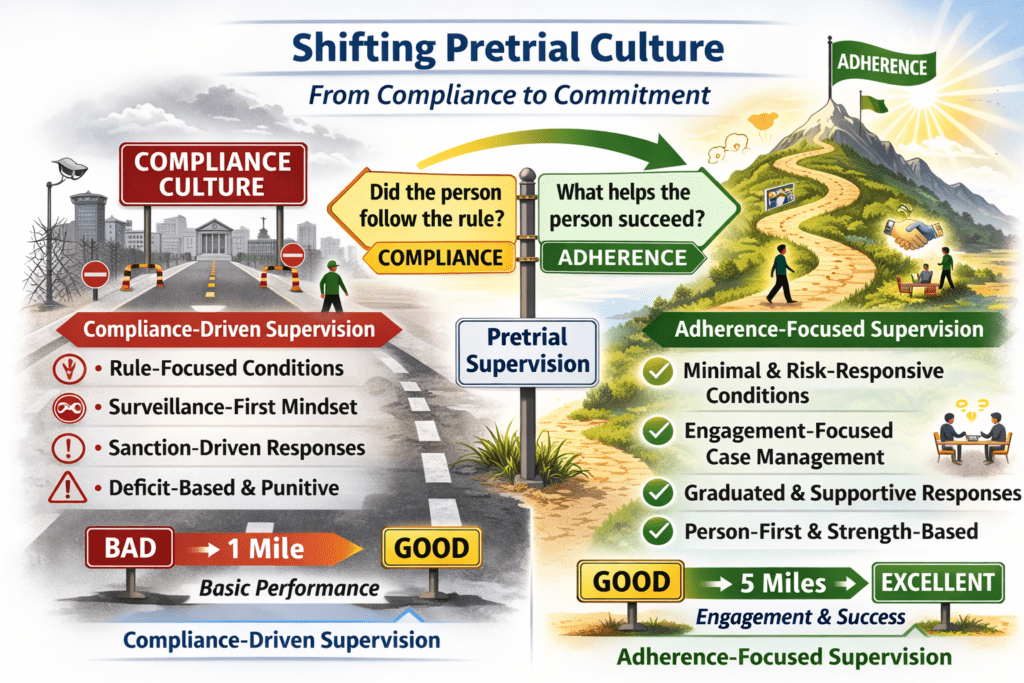
Compliance culture asks a simple question: Did the person follow the rule?
Compliance culture asks a simple question: Did the person follow the rule?
In practice, this can look like:
- Heavy conditioning
- Zero tolerance responses
- Surveillance first approaches
- Frequent focus on technical violations
- Deficit based labels such as noncompliant
- Sanction driven responses
Compliance culture creates structure and accountability. It clarifies expectations and reinforces court authority. That structure can move performance from poor to acceptable. But research shows that compliance alone rarely produces sustained engagement or discretionary effort.
Adherence culture asks a different question: What helps the person successfully complete pretrial supervision?
Adherence shifts from external rule enforcement to internalized commitment. It still maintains accountability. However, it emphasizes engagement, belief, and alignment with purpose rather than surveillance alone.
The distinction is not about being soft. It is about being effective.
What Adherence Culture Looks Like in Pretrial Practice
An adherence oriented pretrial agency does not abandon structure. Instead, it applies structure intentionally and proportionately.
In operations, this often includes:
1. Minimal and Risk Responsive Conditions
- Setting only the least restrictive conditions necessary
- Tailoring supervision intensity to assessed risk and need
- Avoiding over conditioning that increases technical violations
2. Engagement Focused Case Management
- Staff operating more like coaches than compliance monitors
- Strong barrier identification related to transportation, childcare, housing, or substance use
- Use of reminder systems to prevent nonappearance
- Motivational interviewing and collaborative goal setting
- Real time problem solving instead of automatic escalation
3. Graduated and Proportionate Responses
- Distinguishing between willful and non willful nonappearance
- Using supportive interventions before punitive responses
- Incorporating incentives and positive reinforcement
- Avoiding reflexive revocation for technical missteps
4. Person First and Strength Based Language
- Moving away from labels that reduce individuals to rule violations
- Recognizing progress, effort, and stability
- Reinforcing agency and responsibility
When individuals experience fairness, clarity, and respect, compliance becomes internalized adherence. Engagement increases. Outcomes stabilize.
Why This Matters for Organizational Culture
The shift from compliance to adherence is not only about how we supervise clients. It is especially about how agencies function internally. It all starts upstream with leadership and culture. Always. Culture is King.
Compliance based organizational cultures rely heavily on control, hierarchy, and consequences. They produce predictable baseline performance. People do what is required to avoid getting in trouble. However, discretionary effort remains limited. Innovation slows. Burnout increases. Staff disengage quietly.
Adherence-based organizational cultures operate differently.
They emphasize:
- Shared purpose
- Psychological safety
- Appreciation and strengths
- Long term orientation rather than short term reaction
When staff believe in the mission and feel safe to speak up, they contribute more fully. They collaborate across roles. They solve problems proactively. This is the difference between going one mile and going five. If the distance from bad to good is one mile, then the distance from good to great is 5 miles. And that last 4 miles requires an adherence and appreciative mindset.
In pretrial agencies facing reform pressure, staffing shortages, and public accountability, discretionary effort is not optional. It is essential infrastructure.
Culture Is Upstream From Policy
Agencies can adopt evidence-based practices, validated assessment tools, and structured decision-making frameworks. Yet culture determines how well and how often those tools are used.
If culture remains surveillance first, staff may over condition despite policy guidance. If culture remains fear based, innovation stalls. If silence dominates meetings, implementation gaps widen.
Healthy culture supports consistency, fairness, and adaptive learning. It allows agencies to maintain accountability while reducing unnecessary system churn. It strengthens both public safety and procedural justice.
Moving From Good to Great in Pretrial
Compliance can move systems from ineffective to adequate. Adherence moves systems toward sustainable excellence.
For pretrial agencies, this means:
- Maintaining clear standards
- Protecting court authority
- Ensuring public safety
While also:
- Reducing unnecessary conditions
- Supporting voluntary engagement
- Investing in staff culture and well being
- Modeling accountability internally, not just externally
The most effective pretrial systems are not abandoning compliance. They are building on it. They are intentionally creating cultures where accountability and engagement coexist.
Culture is not a soft initiative. It is a strategic lever.
If pretrial agencies want reforms to endure, staff to thrive, and outcomes to improve, culture must be part of the operational conversation.
Moving from compliance to adherence is not about lowering expectations. It is about raising commitment.