Implementating a Strategic Plan from the Top
When we think about strategic plans, most of us picture binders on shelves or slide decks presented once a year, the kind that get politely reviewed and rarely put into practice. But during a recent Learn@Work LIVE episode with Georgia Department of Community Supervision Commissioner Michael W. Nail and Director of Strategic Planning and Analysis Dr. Nick Powell (also an ACJI Affiliate), they reminded us that a strategic plan can be something much more potent in government agency settings. A strategic document can be a living document that shapes how an organization breathes, learns, and grows.
As a follow-up to that webinar, we asked Commissioner Nail and Dr. Powell what it means to champion a strategic plan from the top, especially for leaders who aren’t embedded in day-to-day operations.
How to Keep the Strategic Plan Alive
For Commissioner Nail, one key to ensuring the strategic plan stays visible and meaningful is rhythm. Twice a year, his senior leadership team gathers offsite to revisit the plan. This is not to rubber-stamp progress, but an opportunity to engage in a deliberate conversation about what’s working, what’s not, and what needs to evolve.
“If you only look at it once a year,” he explained, “it just becomes a process you go through. But if you revisit it too often, you lose perspective. Twice a year gives us the balance; enough time to see real movement, and enough structure to make sure it doesn’t drift away.”
Just as importantly, he encourages justice system leaders to treat the plan as their own. You shouldn’t say, “the strategic plan.” Say, “our strategic plan.” This shift in language signals ownership and accountability. Each director leaves those offsite meetings expected to continue the conversation within their own divisions, weaving the plan into staff meetings, hiring processes, and daily decisions.
>> Click here to join ACJI for our next free Learn@Work LIVE webinar <<
What to Do When Resistance Shows Up
What about when people from your agency resist strategic planning altogether? Commissioner Nail doesn’t shy away from this.
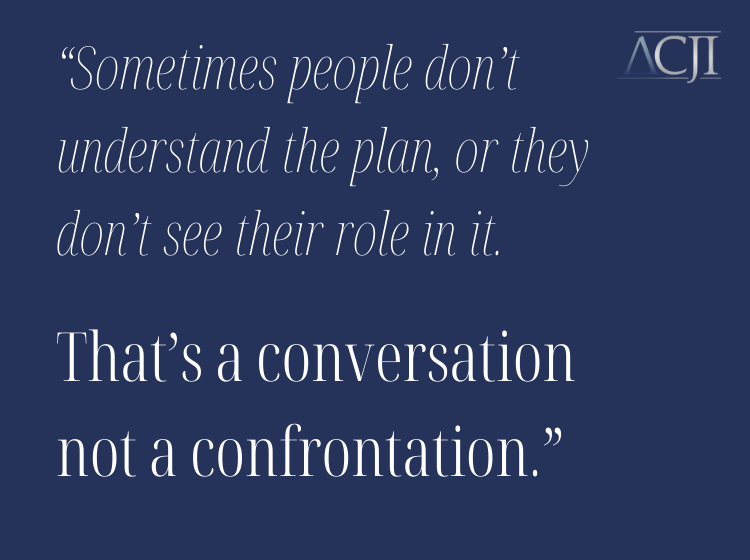
“You have to find where the resistance is coming from,” he said. “Sometimes people don’t understand the plan, or they don’t see their role in it. That’s a conversation not a confrontation.”
He distinguishes between a skills gap (where leaders can teach, mentor, and develop) and a philosophical gap, which is harder to bridge. His job, he says, is to keep dialogue open and ensure people feel safe asking hard questions.
“It’s about creating a culture of dialogue, not directives.”
How Do You Measure Culture Change?
When asked how he measures and monitors organizational culture, Nail’s answer was strikingly simple. He listens.
He sees culture in the way staff at every level — from administrators to senior managers — understand how their work connects to the agency’s mission and strategy. “When a secretary can tell you how their job ties into the strategic plan,” he said, “that’s when you know culture has taken hold.”
He also ties this back to data. He says to use key performance indicators (KPIs) not just to assess outcomes, but to uncover whether gaps stem from misunderstanding, resistance, or a lack of resources.
Strategy as the Art of Sacrifice
Perhaps the most powerful part of the conversation came when Dr. Powell reflected on how leadership restraint can be a form of strength. “Sometimes the best way to champion is to step back,” he said.
Commissioner Nail agreed. “It’s not about me,” he added. “It’s about us.”
Their approach embodies a kind of leadership that prizes focus over frenzy. And in the criminal/legal system, we could all use more focus.
As Nail put it, “You can’t be everything to everybody. Just because you’re not doing it doesn’t mean it’s not a good idea. It just might not be the right time.”
The Big Takeaway
For those in senior roles, implementing a strategic plan isn’t about micromanaging or making every decision. It’s about creating the conditions where others can lead, learn, and carry the vision forward.
As Commissioner Nail summed up, it’s about “ownership, dialogue, and a plan that isn’t just on paper, it’s in practice.”
ACJI's Strategic Planning Intensive
 With a plan in place, you will transition to leading your organization by design rather than letting it run by default. Stop reacting and start strategizing with ACJI as your guide.